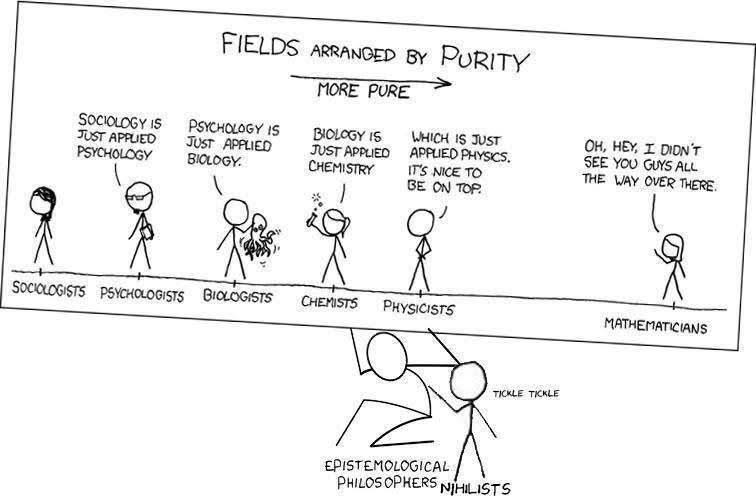
올빼미에 자주 인식론 관련 의문들이 올라오는 것을 보면, 꽤 많은 사람들이 학문의 체계에 대해 위와 같은 이미지를 가지고 있는 것이 아닌가 하는 생각이 듭니다. 개별 학문들이 각각 자신들의 분야에서 '무엇이 지식인지'를 논의한다면, 인식론은 그 모든 학문들 아래에서 '지식 자체가 무엇인지'에 대해 논의하면서 모든 학문들을 떠받치고 있다는 생각 말이에요.
뭐, 위와 같은 이미지에 대해서 저는 매우 비판적인 의견을 가지고 있지만, 제 개인적인 의견보다는 로티의 의견을 소개해 보고 싶습니다.
나는 인식론이나 그 적절한 후속 학문이 문화에 필요하다는 견해가, 철학자가 수행할 수 있는 두 가지 역할을 혼동하고 있다고 생각한다. 첫 번째는, 정보에 밝은 취미가(이른바 소크라테스식 다재다능 중개자)로서 다양한 담론 사이를 오가는 역할이다. 말하자면 그의 살롱에서, 은둔적인 사유자들은 스스로 갇혀 있던 관행에서 매혹적으로 끌어내어진다. 담론과 학문 분야 간의 불일치는 대화 과정에서 타협되거나 초월된다. 두 번째 역할은, 모두의 공통 기반을 아는 문화적 감독자의 역할이다—모두가 그것을 알고 있든 없든 그들이 실제로 무엇을 하고 있는지를 아는 플라톤식 철학자-왕이다. 왜냐하면 그는 그들이 활동하는 궁극적 맥락(형상, 정신, 언어)에 대해 알고 있기 때문이다. 첫 번째 역할은 해석학에 적합하며, 두 번째 역할은 인식론에 적합하다. 해석학은 다양한 담론 간의 관계를, 담론 참여자들을 하나로 묶는 학문적 틀을 전제하지 않는 가능적 대화 속의 실처럼 본다. 대화가 지속되는 한 합의에 대한 희망은 결코 사라지지 않는다. 이 희망은 미리 존재하는 공통 기반을 발견하려는 희망이 아니라, 단순히 합의에 대한 희망, 또는 최소한 흥미롭고 생산적인 불일치에 대한 희망이다. 인식론은 합의의 희망을, 아마도 담론 참여자들이 알지 못하는 사이 그들을 공통의 합리성으로 묶는 공통 기반의 존재를 나타내는 표시로 본다.
[…]
내가 이러한 이상적 대립을 나타내기 위해 인식론과 해석학이라는 용어를 사용한 것은 다소 억지스러워 보일 수 있다. 나는 이를 정당화하기 위해, 전체론(holism)과 "해석학적 순환(hermeneutic circle)" 사이의 몇 가지 연결점을 지적하고자 한다. 정확한 표상으로서의 지식이라는 개념은 자연스럽게 특정 종류의 재현, 특정 표현, 특정 과정이 “기본적”, “특권적”, “근본적”이라는 개념으로 이어진다. 내가 앞선 장들에서 검토한 이 개념에 대한 비판들은, 다음과 같은 형태의 전체론적 논증으로 뒷받침된다. 즉, 우리는 이러한 요소들이 발생하는 전체 구조에 대한 사전적 이해 없이는 기본적 요소를 고립시킬 수 없다. 따라서 우리는 실천의 성공적 수행(successful accomplishment of a practice)이라는 개념을 (요소 대 요소의) “정확한 표상(accurate representation)”이라는 개념으로 대체할 수 없다. 요소들로부터의 “합리적 재구성”을 통해 실천이 “정당화”된다기보다는, 요소에 대한 우리의 선택이 실천에 대한 우리의 이해에 의해 좌우된다.
I think that the view that epistemology, or some suitable successor-discipline, is necessary to culture confuses two roles which the philosopher might play. The first is that of the informed dilettante, the polypragmatic, Socratic intermediary between various discourses. In his salon, so to speak, hermetic thinkers are charmed out of their self-enclosed practices. Disagreements between disciplines and discourses are compromised or transcended in the course of the conversation. The second role is that of the cultural overseer who knows everyone's common ground—the Platonic philosopher-king who knows what everybody else is really doing whether they know it or not, because he knows about the ultimate context (the Forms, the Mind, Language) within which they are doing it. The first role is appropriate to hermeneutics, the second to epistemology. Hermeneutics sees the relations between various discourses as those of strands in a possible conversation, a conversation which presupposes no disciplinary matrix which unites the speakers, but where the hope of agreement is never lost so long as the conversation lasts. This hope is not a hope for the discovery of antecedently existing common ground, but simply hope for agreement, or, at least, exciting and fruitful disagreement. Epistemology sees the hope of agreement as a token of the existence of common ground which, perhaps unbeknown to the speakers, unites them in a common rationality.
[…]
My use of the terms epistemology and hermeneutics to stand for these ideal opposites may seem forced. I shall try to justify it by noting some of the connections between holism and the "hermeneutic circle." The notion of knowledge as accurate representation lends itself naturally to the notion that certain sorts of representations, certain expressions, certain processes are " basic," "privileged," and "foundational." The criticisms of this notion which I have canvassed in previous chapters are backed up with holistic arguments of the form: We will not be able to isolate basic elements except on the basis of a prior knowledge of the whole fabric within which these elements occur. Thus we will not be able to substitute the notion of "accurate representation" (element-by-element) for that of successful accomplishment of a practice. Our choice of elements will be dictated by our understanding of the practice, rather than the practice's being "legitimated" by a "rational reconstruction" out of elements.
Richard Rorty, Philosophy and the Mirror of Nature, Princeton: Princeton University Press, 2009, pp. 317-319, ChatGPT 번역 후 인용자 수정.