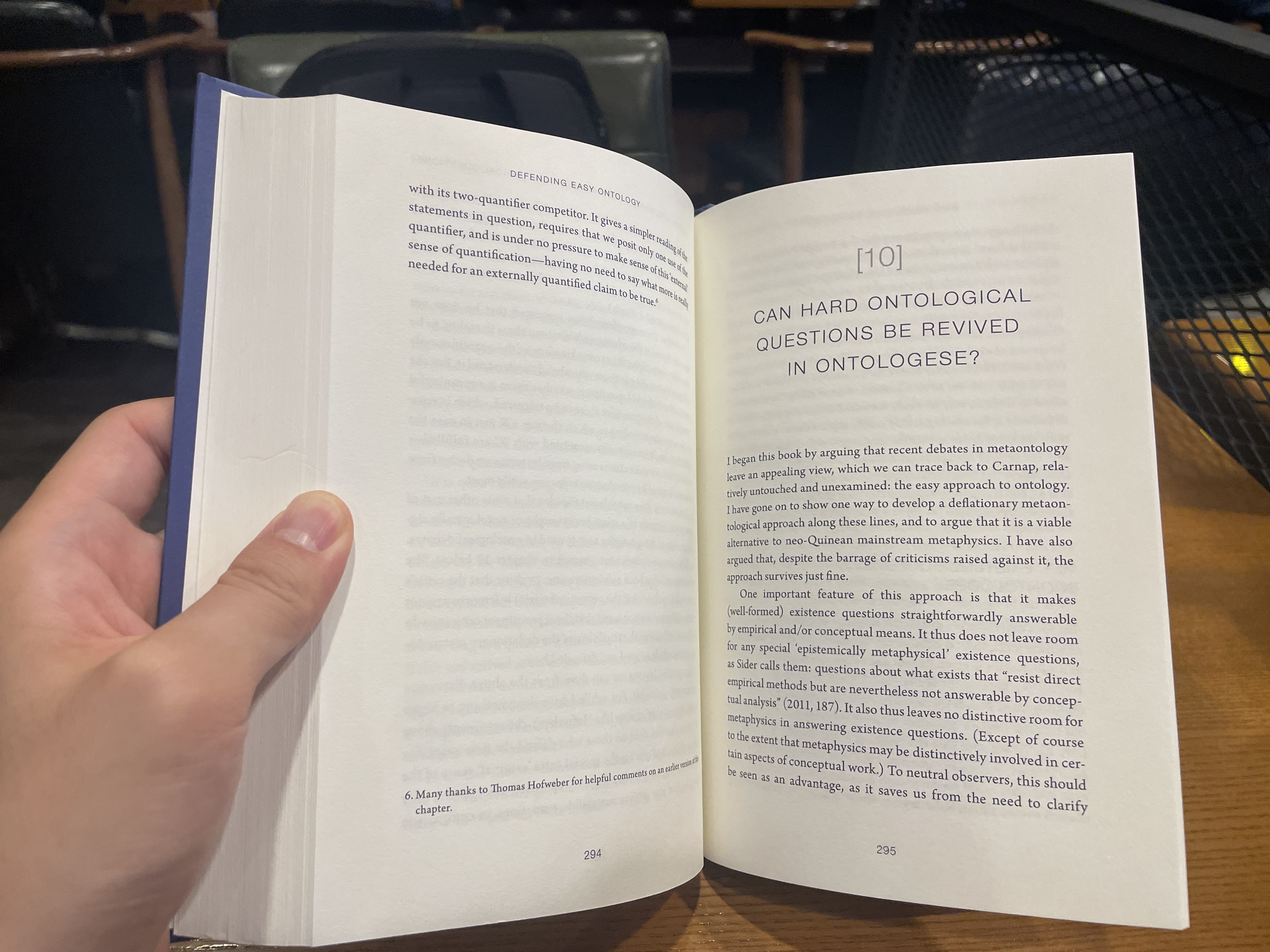
에이미 토마슨(Amie L. Thomasson)의 Ontology Made Easy를 읽는데, 논지를 정말 평이하게 잘 전개하네요. 예전에 대학원 수업에서 메타형이상학 공부할 때 보았던 이쪽 분야 글들은 대부분 너무 어려워서 머리를 싸매고 읽어야 했는데, 토마슨은 상당히 수월하게 읽히는 편이네요. Easy Ontologist는 글도 Easy하게 쓰나 봅니다.
10개의 좋아요
읽어보셨군요!! 양상 규범주의를 다루는 Norms and Necessity와 해당 책 두 권은 정말 명작이라고 생각합니다!
4개의 좋아요
스터디에 참여하게 되어서 제가 발제할 10장 부분을 읽어보았는데, 논지가 아주 마음에 들던데요! 사이더 글들을 읽을 때마다 ‘이렇게 유명한 논리철학자가 양화사를 실재론적으로 해석하려 한다고? 논리학은 형이상학에 대해 중립적이지 않나? 내가 논리학에 대해 뭔가 몰라서 그런가?‘하고 의아하게 생각했는데, 토마슨이 정확히 그 가려운 부분을 긁어줘서 정말 시원하더라고요.
(a) 세계의 구조에 대해 반실재론적 태도를 취하는 것과 중립적 태도를 취하는 것은 애초에 다른 문제인데, 사이더는 그걸 구분 못하고 있다.
(b) 논리학은 형이상학에 대해 중립적인 분야인데, 사이더는 자꾸 논리학에서 실재론적 함의를 도출하려 한다.
가 기본 논지라고 이해하였는데, 저는 격렬하게 동의가 되었습니다.
4개의 좋아요
토마슨의 말장난이 빛을 발하는 순간이네요. 'x made easy'는 전형적인 개론서 제목 형식이니깐요. 존재론은 쉽고 개론서 이상이 필요없다는 토마슨의 야망이 보이는 말장난이기도 한 것 같아요.
4개의 좋아요
근데 토마슨이 정말 사이더를 그렇게 설명하나요? 제가 이해하기로 사이더는 논리학으로부터 실재론적 함의를 도출하려고 하지 않아요. 사이더는 대신 반실재론에 대해 다음과 같은 반박들을 제시합니다. 댓글에서 이 반박들을 제대로 적긴 힘들기 때문에, 적당히 가락만 적고
이게 사실이 아니라는 것에 초점을 맞추겠습니다.
반박 1. No foundation
A more promising objection presses the following questions on the quntifier variantist: what is fundamental, if quantification is not? What is the world fundamentally like? How will you write the book of the world? As we'll see, these questions are difficult for the quantifier variantist to answer (Writing the Book of the World pp. 182, Sider's emphasis).
그리고 사이더가 생각하기에 양화사가 근본적이어야하는 이유 중 하나는 물리학과 수학이 양화사를 이미 전제하고 있기 때문입니다. 사이더는 다음과 같이 말합니다:
Quantification is deeply embedded in all physical theories as normally understood, as well as in the mathematical theories they employ. Imagine trying to state a physical theory without quantifying at all. You couldn't quantify over points or regions of space or time or spacetime. You couldn't quantify over points or regions of configuration space or phase space or any other higher-order space. You couldn't quantify over real numbers, or functions of real numbers, or vectors, or tensors, or any other mathematical entities. Your attempt wouldn't even get off the ground (Writing the Book of the World, pp. 183).
그리고 사이더가 보기에 근본적인 언어는 비근본적인 언어에 대한 metaphysical semantics를 쓸 줄 알아야합니다 (예를 들어, "Ex Cx" 라는 문장이 있고, C = being a city라는 성질이라고 해봅시다. 그렇다면 C는 근본적인 성질이 아니고, "Ex Cx"는 근본적인 언어로 쓰여진 문장이 아니기 때문에 "Ex Cx"는 더 근본적인 언어로 쓰일 수 있어야합니다. 예를 들어 미시적인 것들에 대한 문장으로 저 문장을 쓸 수 있겠네요.). 그렇다면 근본적인 언어는 물리학과 수학에 대한 metaphysical semantics가 있어야하며, 그 언어는 양화사를 포함해야하죠. 사이더는 물리학과 수학의 양화사적 성질에 집중을 하면서 근본적인 언어가 양화사를 포함해야한다고 주장을 하는 것입니다. 반실재론은 (1) 물리학과 수학이 양화사없이 성립할 수 있다고 주장하던가 (2) 양화사가 없는 근본적 언어가 양화사를 포함하는 언어의 metaphysical semantics를 쓸 수 있다고 하던가 (3) 근본성을 아예 포기를 해야합니다. 사이더는 논리학이 아닌 수학과 물리학의 양화사적 성질에 기반해서 반실재론에 반박을 하는 중이고, 반실재론자들은 (1) 부터 (3) 중 하나를 선택하고 주장해야하는 논증 책임을 지는 것 같습니다.
반박 2 No epistemic high ground
이 반박은 반실재론 자체를 공격하는 것이 아닌 반실재론의 동기를 부정하는 것입니다. 양화사 변이자와 같은 반실재론자들은 자신들이 인식론적으로 더 좋은 위치 (epistemically high ground) 에 있다고 생각합니다. 왜냐면 존재론적 실재론은 예로부터 해왔던 질문들을 방법론을 바꿔가면서 답을 해왔지만 큰 성공은 없었습니다. 그래서 반실재론자들은 자신들의 이론이 인식론적으로 더 좋은 위치에 있다고 하는 것입니다.
사이더는 한 편으로는 존재론적 실재론이 성공이 없었다는 것을 인정하는 것 같으면서, 반실재론이 인식론적으로 더 좋은 위치에 있다는 것을 부정합니다. 특히 양화사 변이를 주장하는 사람들은 (앞서 본 (2)를 택하면서) 근본적 언어에서 양화사를 대체할 무언가를 찾아야하고, 그 답을 찾는데 있어 인식론적으로 더 좋은 위치에 있지 않다고 주장합니다:
I argued in abstract terms in section 5.6 that such attempts to gain the epistemic high ground are misguided, and this particular case is no exception. For quantifier variance doesn't dispel the unanswerable questions -- not even those in the vicinity... As we saw in section 9.6.2 [i.e. the section on the 'no foundation' argument], once the quantifier variantist has banned quantifiers from her fundamental language, there is pressure to specify their replacements. And on many of the replacements discussed there, new epistemically metaphysical questions -- analogous to the rejected questions of ontology -- re-emerge. (Writing the Book of the World, pp. 187).
사이더는 양화사 변이자들이 근본적 언어에서 양화사를 대체하게 되면 실재론보다 유의미하게 인식론적으로 좋은 위치에 있다고 하기 힘들다고 합니다. 그렇기 때문에 양화사 변이와 같은 반실재론을 채택할 동기를 부정합니다. 이 역시 논리학으로부터 실재론을 읽어내는 것이 아닙니다.
반박 3: Indispensability Argument
이 반박은 사이더가 보기에 가장 강한 반박이면서 굉장히 단순합니다:
The way to tell which notions carve at the joints is broadly Quinean: believe in the fundamental ideology that is indispensable in our best theories. This method yields a clear verdict in the case of quantification. Every serious theory of anything that anyone has considered uses quantifieres, from physics to mathematics to the social sciences to the folk theories. And as we saw in section 9.6.2 [i.e. via the 'no foundation' argument], there is no feasible way to avoid their usage. Quantification is as indispensable as it gets. This is defeasible reason to think that we're onto something with our use of quantifiers, that quantificational structure is part of the objective structure of the world, just as the success of spacetime physics gives us reason to believe in objective spacetime structure. (Writing the Book of the World, pp. 188).
사이더는 콰인의 방법론을 쓰면서 양화사가 꼭 필요하다고 말합니다. 이 역시 논리학으로부터 실재론을 읽어내는 것이 아닌 수학과 물리학과 같은 학문들을 고려했을 때 나오는 방법론적 결과입니다.
물론 사이더의 반박들이 전부 성공한다고 말하고 싶은 것은 아닙니다. 저는 물론 실재론자들로써 이 반박들에 많이 동의를 하지만요. 제가 여기서 말하고 싶은 것은 사이더는 논리학에서 실재론적 함의를 도출하려 한 것이 아니라, 수학과 물리학의 양화사적 성질에 기반한 반박, 인식론적인 반박, 그리고 방법론적인 반박을 하고 있다는 것입니다. 윤님의 토마슨은 사이더를 잘못 읽고 있는 것처럼 보입니다.
4개의 좋아요
제가 (b)로 요약한 논의가 10.4. Problematizing the Joint-carving Quantifier에서 나와요. 토마슨이 '술어(predicate)'와 '양화사(quantifier)'를 구분하면서, 술어는 사이더의 주장처럼 특정한 결을-깍는(joint-carving) 기능을 지닐 수 있을지도 모르지만, 양화사는 그런 기능을 지니지 않는다고 지적하거든요.
The predicates of physics and biology, for example, might be acknowledged to have a certain kind of joint-carving function even if the quantificational apparatus of our language serves an entirely different function. The idea of terms that carve at the joints of course (as Sider fully acknowledges) was introduced to characterize natural kind terms—predicates of a particular kind. And in that context it may be well motivated. But whether it generalizes to logical terms such as the quantifier is another question. (Thomasson, 2015: 308-309 my emphasis)
그러면서 토마슨은 양화사 같은 논리적 개념들이 순전히 '형식적' 역할만 수행한다고 강조해요. 그리고, 논리적 개념들의 형식적 역할만을 강조한다고 해서 토마슨 자신의 주장이 '규약주의' 같은 또 다른 형이상학적 입장에 개입할 필요도 없다고 지적하고요. 적어도, 논리학에 대한 철학사의 일반적인 이해에서는, 논리적 개념들이 형이상학에 대해 '중립적'이고 순전히 '형식적'이라는 입장이 지배적인 이해이고, 그 입장을 거부하려 한다면 사이더야말로 자신의 주장에 대한 입증 책임을 져야 한다고 비판하더라고요.
But the idea that logical notions are merely formal by far predates logical conventionalism. Early versions of the idea appear already in Aristotle, and arise again among medieval philosophers such as Duns Scotus. In its modern form, the view can be traced back at the very least to Kant (who was certainly no conventionalist). As we have seen in chapter 1, the idea that ‘exists’ does not aim to describe objects but rather plays a formal role analogous to number concepts appears also in Frege and Carnap. (Thomasson, 2015: 310-311)
The idea that logic is—in some sense—formal or topic-neutral is, as John McFarlane (2000) makes clear, historically central, indeed perhaps the historically dominant conception of logic—and one endorsed by such diverse philosophers as Kant, Lotze, Husserl, Frege, and de Morgan. It is not to be quickly tossed aside by associations with (an uncharitable interpretation of) the conventionalism of logical positivists. The basic idea has nothing to do with logical truths being ‘made true’ by our adoption of certain conventions, or with the idea that we may ‘legislate’ certain sentences to be logically true. Thus Sider’s arguments against conventionalism leave this view untouched. (Thomasson, 2015: 311)
그리고 토마슨은 논리학이 '주제 중립적(topic-neutral)'이라는 사실로부터, 논리학이 세계의 구조를 주제로 삼는다는 사이더의 주장이 잘못되었다고 비판해요.
We can again look to the history of treatments of logic as formal for some ideas along these lines. The basic idea behind the classical treatment of logic as formal is the idea that logic is topic-neutral, or independent of subject matter (McFarlane 2000, 51). But if logic is topic-neutral, then its topic is not the structure of the world; unlike the terminology of biology, political science, or physics, it is not attempting to map the structure of a particular part of reality. (Thomasson, 2015: 312 my emphasis)
적어도, 토마슨은 사이더가 논리학을 '주제-중립적'이라고 생각하지 않는다고 보고 있어요. 가령, 사이더에 따르면, 양화사는 무엇에 '대한(about)' 것이어야 하고, 그 '무엇'이 바로 세계의 구조를 표상하고 있다는 게 사이더의 생각이라는 거죠. (그리고 제가 보기에도 사이더가 자주 이런 주장을 하지 않나요? 당장 사이더의 문헌에서 구체적인 구절이 떠오르지는 않지만, 예전에 공부할 때 사이더가 너무나 당연하게 양화사를 세계의 구조에 대응시키려 했던 걸로 기억해서요.)
In response, Sider has urged that logic is not topic-neutral, since it is ‘about’ the content of the logical constants: about conjunction, disjunction, quantification . . . Perhaps there is a merely verbal sense in which we can say that logic is ‘about’ conjunction, disjunction, and the rest—though even this sounds odd, and is not how the subject is typically introduced (think of the first day of logic class, in which one promises the class not that they will learn all about what conjunction really is, but rather that they will gain skills in analyzing arguments on any subject, to determine which are valid and which invalid). But even if we do say that logic is ‘about’ conjunction, disjunction, or quantification, given the formal conception, this should not be taken in a representationalist sense of ‘about’ where the terms are introduced to enable us to track and investigate what they name (as terms for species of plants and birds might be). The point of the formalist conception is that logical terms serve a very different function. (Thomasson, 2015: 314 my emphasis)
*아마도 @yhk9297 님께서 지적하신 내용은 제가 요약한 내용 중에서 (b)보다도 (a) 부분에 관련된 것 같아요. 사이더는 양화사 변이론자들이 형이상학에 개입해야 한다고 주장하지만, 토마슨은 쉬운 존재론이 형이상학에 개입할 필요가 없다고 강조하거든요. 그 내용은 한 절 앞인 10.3. Avoiding the Joint-carving Quantifier에서 다루어져요.
2개의 좋아요
전 b에 관해서 얘기를 한 것이었어요.
제 논지는 사이더의 주장이 논리학에서 실재론적 함의를 도출하려 한 것이 아니라는 것이었거든요. 그러니깐 사이더의 주장은 b (아마 윌리엄슨의 Modal Logic as Metaphysics라던가 타이텔의 "Contingent Existence and the Reduction of Modality to Essence" 과 같은 주장들?) 와 다르다는 것이었죠. 적어도 Writing the Book of the World에서 사이더는 반실재론에 대한 반박들로 위 반박들을 언급하기 때문에 사이더가 반실재론을 다루면서 논리학에서 실재론적 함의를 도출하려고 했다는 게 이해가 안 가요. 위 반박들 중에서 논리학에서 실재론적 함의를 도출하려고 하는 시도는 없었던 것 같거든요. 어쩌면 토마슨은 사이더의 다른 저작을 논하는 것이었을까요? 아니면 사이더의 negative argument (반실재론에 대한 반박) 이 아닌 positive argument (실재론을 위한 주장)이 그렇다고 주장할 수도 있겠네요. 다만 저는 사이더의 positive argument도 논리학에 기반한 주장은 아니라고 생각합니다.
언급하신 토마슨의 답도 사실 만족스럽진 않습니다. 사이더는 논리학이 무엇에 관한 것이다, 양화사가 무엇에 관한 것이다 주장하는 게 아니에요. 사이더는 근본적인 언어가 양화사를 포함해야하는지에 대해 논하는 것이에요. 이때 사이더의 주장은 근본적인 언어는 덜 근본적인 언어의 metaphysical semantics를 마련해야한다는 것이에요. 그리고 수학과 물리학과 같은 덜 근본적인 언어는 양화사를 포함하기 때문에 근본적인 언어는 이에 대한 metaphysical semantics를 마련해야하고, 그렇기에 (1) 근본적인 언어가 양화사를 포함하거나 (2) 그렇지 않아야하는데 반실재론은 (2)를 택할 수 밖에 없고 그렇다면 문제가 생긴다는것이죠.
조금 바꿔 말하자면, 사이더는 근본적인 언어, 비근본적인 언어 모두 논리학으로 표현될 수 있다고 생각해요. 그러니깐 논리학은 구조에 관해 중립적이죠. 구조에 관해 중립적이지 않은 것은 근본적인 언어에요. 근본적인 언어는 논리학으로 표현이 되지만 그렇다고 해서 구조에 중립적이라는 뜻은 아니에요. 근본적인 언어는 구조에 관한 언어이면서 논리학으로 표현이 될 뿐이에요. 그리고 사이더의 주장은 근본적인 언어가 양화사를 포함하거나 포함하지 않아야하는데, 근본적인 언어가 양화사를 포함하면 반실재론을 포기하는 것이며, 근본적인 언어가 양화사를 포함하지 않으면 양화사에 대한 metaphysical semantics를 마련하는 것에 대해 어려움이 생긴다는 것이지요. 그렇기 때문에 저는 사이더가 논리학의 주제중립성을 해치지 않았다고 생각해요.
더 나아가면, 제가 보기에 사이더는 논리학의 주제중립성을 해치지 않았기 때문에 근본적인 언어가 비근본적인 언어가 논리학으로 쓴 문장들 (다시 말하면 수학이나 물리학에서 쓰는 양화사가 관련된 문장들)의 metaphysical semantics를 마련할 수 있어요. 만일 사이더가 논리학의 주제중립성을 해치고 논리학이 세상의 구조에 관한 것이라고 봤다면 애초에 수학이나 물리학 혹은 다른 사회 과학에서 쓰는 논리학적인 문장들이 모두 구조에 관한 것이라고 주장해야돼요. 그렇다면 사이더는 그 문장들의 metaphysical semantics가 있어야한다고 주장할 수가 없겠지요. 왜냐면 사이더의 요지는 근본적인 언어가 비근본적인 언어의 metaphysical semantics를 마련해야한다는 것이니깐요. 하지만 사이더는 논리학이 주제중립적이기 때문에, 즉 논리학으로 쓴 문장들 중에 구조에 관한 문장이 아닌 것이 있기 때문에 근본적인 언어가 그 문장들의 metaphysical semantics를 마련해야한다고 주장할 수 있는것이지요. 그러니깐 사이더는 논리학의 주제중립성을 믿기 때문에 오히려 근본적인 언어의 metaphysical semantics에 대해서 논할 수 있는 것이지요. 사이더의 주장은 논리학의 주제중립성이 없었다면 성립할 수 없는 것 같습니다.
6개의 좋아요